• Skip to primary navigation
  • Skip to main content
  • Skip to primary sidebar

Terraformers

Movements Towards a Pristine Planet

  • Home
  • Permaculture
  • Blog

The Drone Industry Boom: Your Chance to Get In

Filed Under: Blog

Drone technology has made giant leaps forward in recent years, mainly driven by war, especially in Ukraine. But, this tech is growing in positive directions as well. Drones are being used for a wide array of uses such as: land survey, deliveries, video recording, and spreading seeds in agriculture, to name a few.

The drone industry is certain to continue expanding in the coming years and decades. This will present huge opportunities for you to either create or work for a drone business.

I hope this post inspires you and gives you new ideas about getting into this field. History has shown that new tech can breed hundreds of thousands of new jobs and thousands of new companies.

General Drone Businesses

Think about all the branches that make up the auto industry. Drones will be needing their own services and parts, too. Maybe you could get into batteries, electronics, drone design, sensors, cameras, etc.

Drone Manufacturing Plants

Demand for drones will grow! Small plants or assembly lines with people and robotic automation is a path you could take. If you have experience with building things in bulk, drones are a great business to research.

Repair Shops

Drones also need to be repaired, which is a growing business model. You can become a drone mechanic! Maybe you could have a mobile repair business so you wouldn’t need to rent a shop.

To go along with repairs, the creation of drone parts will be needed more and more. Many parts can be 3D printed, which could be a great business on its own.

Specific Use Cases

You can also focus on building a business within one specific drone use. It can be a use where you have experience or an interest. Yeah, there are the war uses, but here is a list of more peaceful ones that exist right now.

Scouting and Mapping of Land

Drones can be used in land surveys and searching remote areas.

Search and Rescue

Since swarms of drones are being used to track soldiers in war, they can be applied to missing people, even over areas of the ocean. Instead of dropping grenades and bombs, they can provide water and food to someone that is lost!

Spreading seeds and Planting Trees

Drones are alrady being used to spread cover crop seeds on farms. Large drones are even shooting trees seeds into the soil. The concept is proven and growing.

Taking Videos

If you like shooting videos, get into the drone video game. Sports such as surfing, skiing, snowboarding, skateboarding, motorcycles, and countless others love to get captured by drone vid.

The Intersection of AI and Drones

A massively impactful combination in the near future will be artificial intelligence and drones (AI with robotics, too). Drones are no longer toys that are souped up. Their uses are being expanded with onboard intelligence.

A specialized AI agent on a drone will be huge in the near future. There are countless possibilities such as: atomospheric studies, ecology sciences, ocean science, animal studies, and helping with forest fires, to name a few.

The only limit at this junction will be your own imagination. What is an interest that you have where a specialized agent in a robot or drone will have an impact?

Innovating and Inventing Drone Uses

Drone technology is so new that you can start your own industry within it! Being an innovator in a field is a way to put a dent in the world.

Some ideas: firefighting, seed spreading, cleaning buildings, transport / flying cars, delivery. Ask AI to help you brainstorm!

Fun with Drones: Sports and Customization

You could start drone competitions, maybe battles or a drone olympics! You could get into customizations with paint, new designs, batteries, sensors, onboard AI. It could be a thing…

Upgrade the Design, Improve the Tech

Drones are wide open for improvements to the underlying engineering, too. It’s another area that is needed and where you can make a name for yourself, as well as a lot of money. You don’t need to be an engineer. Just start studying drones!

Integrating and improving systems such as solar for longer flights, battery upgrades, camera integrations, various sensors, and parachutes for drones will be huge areas to research. Upgrading their rotor configurations, carrying capacity, and speed will also be a need.

You could even reinvent their design completely. I know there are efforts right now to mimic or even integrate biological systems. The future is getting weird.

The sky is the limit with drones. Yes, I love my terrible puns. It all starts with research if you are interested in this field. Maybe try to get a job where you can learn and innovate even faster.

Then, apply your imagination, write up your thoughts and plans, and ask AI for suggestions. The drone industry will continue to redefine our civilization in the coming decades. Please try to steer it in a positive direction!

How to Create a Successful Permaculture Club

Filed Under: Blog

Regenerating and positively terraforming the Earth is a decentralized movement. It is being done with small groups of dedicated people around the world. From regenerative farmers to permaculturists, these movements have exploded in recent decades.

In addition, people in modern society are desperate for community, purpose, and a reconnection to the environment. A local permaculture club provides all three of those needs. They are easy and fun to start. Just tell yourself you are founding one right now and so it is!

I’ve been helping with small scale permaculture and local gardening efforts for 16 years. In this article, I will share the tactics and steps that are effective at building a local permaculture club. Try a few from this guide consistently and you might be shocked at the results.

Start Super Small

Don’t wait until you have everything figured out. The first “club meeting” can be two or three people, a pot of coffee, and a shared curiosity about growing food while healing the land. Every big movement started with a small group of people who cared.

Pick simple questions to discuss: How can we start growing food cheaply? What resources do we have now?

Start with learning basics and then implementing on a small scale with inexpensive tactics. Scrap wood can turn into a raised bed. Old containers can be used for plants.

Find a Club Base

One member’s house can start as a base. Maybe it is where the land is or where a greenhouse can be built to start seeds.

There are plenty of other places to partner with and grow food: churches, coffee shops, city lots, libraries. Meetings can be held at a community center, small business, park, local farm, garden, or a library meeting room. Use your imagination and ask around. You might just gain new members through inquiring.

The right location signals to people what your club is about and gives you free advertising.

Make a Simple Online Presence

Post on social media. Make a social page or a small website.

People need to find you online before they can join you.

Before your first official meeting, create a basic digital footprint. You don’t need a fancy website. You just need to be findable by people already searching for this.

Easy Offline Advertising

Simple posters or mini ads on 3 x 5 cards can bring free exposure. Hand drawn ads with markers actually stand out against a wall of business cards. Ask to put them up at coffee shops or other stores. Don’t litter and spam the area, though!

Use white buckets for your projects. Put the name of your permaculture club, social media handles, and your website if you have one. You can use markers or even create stickers.

Use Free Internet Postings

  • Create a free Meetup.com group.
  • Make a Craigslist ad.
  • Start a simple Facebook group.
  • Post on X.com
  • Post in local NextDoor and community Facebook groups.
  • Use keywords like “permaculture”, “organic gardening”, “regenerative gardening,” plus your town or city area.

Partner with what Already Exists

Almost every town already has garden clubs, environmental groups, farmer’s markets, or sustainability committees. These are your instant allies. Ask about volunteering with them. You can sometimes get free plants if a location has too much of something. Partnership multiplies your reach without multiplying your workload.

  • Reach out to your local master gardener program
  • Connect with community garden coordinators
  • Rent community garden plots
  • Volunteer at regenerative or organic farms to learn
  • Talk to your local food bank. They often love growing partnerships
  • Contact your city or county sustainability office
  • Rotary Clubs are also very welcoming

Focus on Hands on Learning, not Lectures

People join clubs to grow personally, take action, and get things done.

The fastest way to kill a new club is to make meetings feel like boring presentations. Instead, make every gathering a hands-on learning experience that people talk about all week.

Getting to Work

  • Work on expanding a club member’s garden.
  • Host a simple seed-saving workshop.
  • Have a plant exchange.
  • Pick up trash around town.
  • Do a group “observation walk” in a local park or garden
  • Watch and discuss a short documentary together
  • Invite a local farmer or gardener to share their story

Have meetings and projects often, at least two a week since not everyone will be able to show up for one. This keeps the club foremost in the minds of members and provides momentum.

Connect to a Bigger Vision – Terraforming

People don’t just want to grow tomatoes. They want to feel like their small actions connect to something meaningful on a global scale.

  • Frame your club as a local node in a global restoration movement
  • Connect with wider movements such as: Guerrilla Gardeners, Incredible Edible
  • Share stories of large-scale land restoration projects around the world
  • Help members see that their backyard garden is a piece of planetary healing
  • Teach about movements around the world such as: regenerative agriculture, permaculture, regreening deserts, and agroforestry.

Start a Visible Community Project Quickly

Nothing recruits new members like something people can see. Abstract ideas attract thinkers and that is fine. Visible projects attract doers.

Make a logo and a motto. Add posters or signs for the club with social media contact or website link. Within your first month, launch one small but visible project that the whole community can witness and interact with.

  • Plant a small food forest or garden in a public space
  • Build a free community herb garden
  • Create a “seed library” at your local library
  • Adopt and restore a neglected piece of public land
  • Adopt a city lot around a building. Partner with the town.

Keep the Money Simple and Transparent

Financial confusion can be a killer for a community club. Address it immediately!

You don’t need much money to start, but you need a clear, honest approach to whatever money you do handle. Keep it simple and transparent. Make sure every member understands where dollars come from and where they go.

  • Start with a small voluntary dues model, even $5 / month per member adds up
  • Have all the members vote on what is bought.
  • Explore local grants from community foundations and environmental organizations.
  • Partner with local businesses for sponsorships in exchange for visibility.
  • Research opening a food stand or selling plants.

Talk about and Publicize Permaculture Club!

Consistent, public storytelling is what separates clubs that fade out after six months from movements that grow and branch off for decades. Document everything online. Share everything. Celebrate small wins loudly.

  • Post weekly updates on social media showing real progress.
  • Write simple blog posts or newsletters after each meeting.
  • Send press releases to your local newspaper. Local media loves these stories.
  • Create short videos of your projects for YouTube, Tiktok, and Instagram Reels.

Make Every Member a Leader

The club should never depend on just one or two people. Show every member how the leaders run the club. Delegate for when the top two or three people are gone.

The most common reason community clubs fall apart is that one passionate founder burns out and takes the whole thing down. Design for shared leadership from the very beginning.

  • Rotate meeting facilitation among members.
  • Have members rotate teaching a skill or lesson. Cross training is powerful.
  • Create simple roles such as: Communications Lead, Head of Marketing, Project Lead, Events Lead, Treasurer
  • Mentor newer members into leadership positions early.
  • Document your processes so the club outlives any single person. Have shared club documents on something like Google Drive.

An Underlying Idea

A permaculture club should improve the lives of each member. Work can be done at a member’s house to install a food forest, build raised beds, create a greenhouse, compost pile, or plant trees. More food is grown within the club and the club grows stronger.

Now Get Started

You don’t need permission to start. You just need to begin. Send one text to two friends today. That’s how every movement in history started, with one conversation between people who gave a damn.

Keep refining your vision and mission. It will expand into a huge success with consistency and by following permaculture principles.

If you feel it needs more structure or has become big enough, then consider changing it into a cooperative, collective, or a company. In this way, your passion could becomes an even bigger source of good.

Permaculture Club Terraformers.org

5 Ways Robots and Drones will Help Restore the Planet

Filed Under: Blog

The pace of robotic and drone advancements is dizzying. Every week, their new abilities amaze me. If you work towards it, they will become key tools and helpers in restoring our planet’s ecosystem.

I was asking Claude AI about this last night. It gave some fascinating asnwers, so I made it into a little video. I edited the answer and added my own thoughts down below.

1. Seed Bombing on a Massive Scale

Imagine a fleet of drones flying over a barren desert or a burned area, dropping millions of seed pods. They would be precisely placed and perfectly timed for the rain season.

The AI and planning team guiding them have already studied the soil, the slope, the wind patterns, and the local ecosystem. It knows which seeds need to be dropped where.

What would take an army of humans years to plant, a robot fleet could accomplish in weeks. And they never get tired.

Drones are already being used around the world for cover cropping and planting tree seeds. This will continue to evolve. The drone industry is one to consider joining. You can be an innovator in this space.


2. Soil Health Monitoring of a Wide Area

Healthy soil is the foundation of everything. But now, most farmers and land managers are blind to the state of their environment. They test their soil maybe once a year, if at all. It is expensive, takes time, and samples need to be sent to a lab.

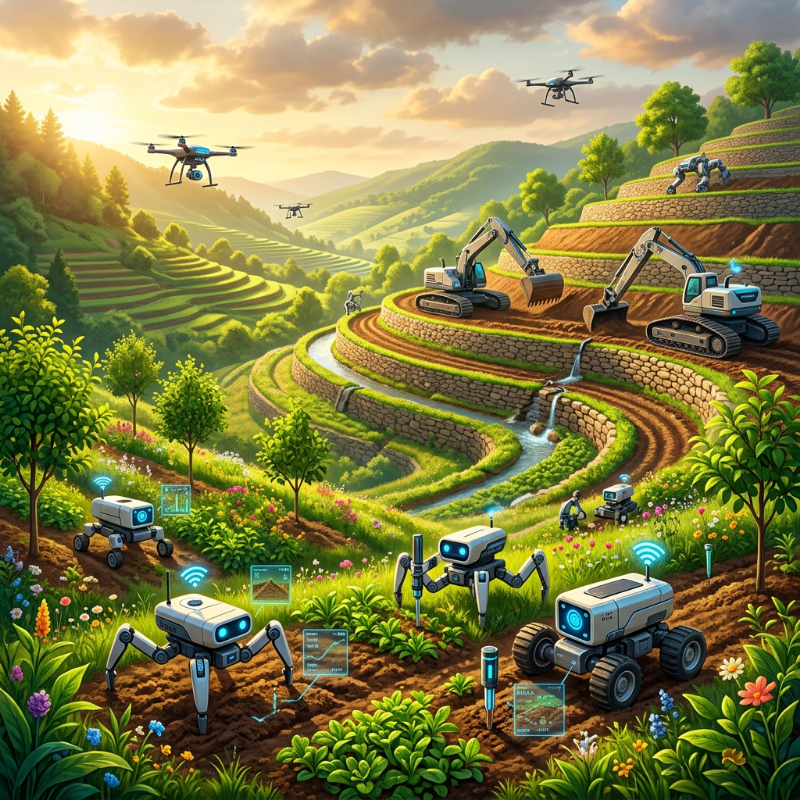
In the near future, imagine small ground robots (maybe little rovers) moving through fields and forests 24/7. They could be reading soil moisture, carbon levels, fungal networks, and nutrient data in real time.

That information could feed directly into a living map of the land. You’d know exactly where the land needs help and what kind of help it needs. I foresee specialized soil scientist AI agents being the brains for these bots.


3. Precision Weeding Without Poison

One of the biggest challenges to regenerative farming is weed control. Right now, the default answer is herbicides which are chemicals that damage the soil life we’re trying to rebuild.

Large robots now exist which identify weeds and kill them with a freakin’ laser beam! The future of robotics will be smaller, coordinated groups of them. Future bots will be solar-powered and remove them mechanically or with that laser without touching a single beneficial plant nearby.

No chemicals. No soil damage. Just precise, intelligent weeding.


4. Water Harvesting and Restoration in Dry Lands

Water is the lifeblood and basis of any restoration project, especially in deserts. Robots could be deployed to build swales, gentle ditches that follow the land’s contour lines and slow water down, sinking it into the earth rather than letting it run off. We are already seeing autonomous tractors. This is another trend I am sure will continue.

Swales are one of the oldest permaculture techniques on Earth. But doing it by hand across thousands of acres? Nearly impossible. With autonomous earth moving robots guided by AI terrain mapping, we could reshape entire landscapes to catch and hold rainfall literally turning dry land green over time.

In projects around the world, these water catching earthworks rehydrate the land, lengthening times that creeks flow and helps build the soil life.


5. Rewilding With Intelligent Habitat Building

Restoring an ecosystem isn’t just about plants. Animals, insects, and birds need shelter, corridors, and nesting zones to return. Robots could be programmed to build wildlife habitat structures such as log placements, rock arrangements, pollinator banks, bird nesting sites.

This could be based on the species that have been detected in the area by sensors and cameras. Large numbers of robots could become partners to nature itself (if we program them correctly). By pairing with AI models, they could be reading what the wild community needs and quietly building it, piece by piece.


The Big Picture of Robotics for Ecological Restoration

None of these five things are science fiction. Every single one is either being used somewhere on Earth right now, or is within reach in the next few years of tech advancement.

The question was never really “Can we do this?” The real question is “Will you decide to be a pioneer in these fields?”

There are entire industries and services waiting to be invented by you.

Robots Restoring the Planet
  • « Go to Previous Page
  • Page 1
  • Page 2

Primary Sidebar

Welcome, Terraformers!

I believe the movements of permaculture, land restoration, regenerative agriculture, recycling efforts, and regreening the deserts are all one impulse to positively regenerate and terraform the Earth. With AI, robotics and drones, we have new tools to multiply our efforts.

Turn your back on old, destructive ways and consider yourself a postive Terraformer from here on out.

Shifting your focus to healing the planet immediately brings you purpose and community.

Copyright © 2026 Terraformers.org | Privacy Policy