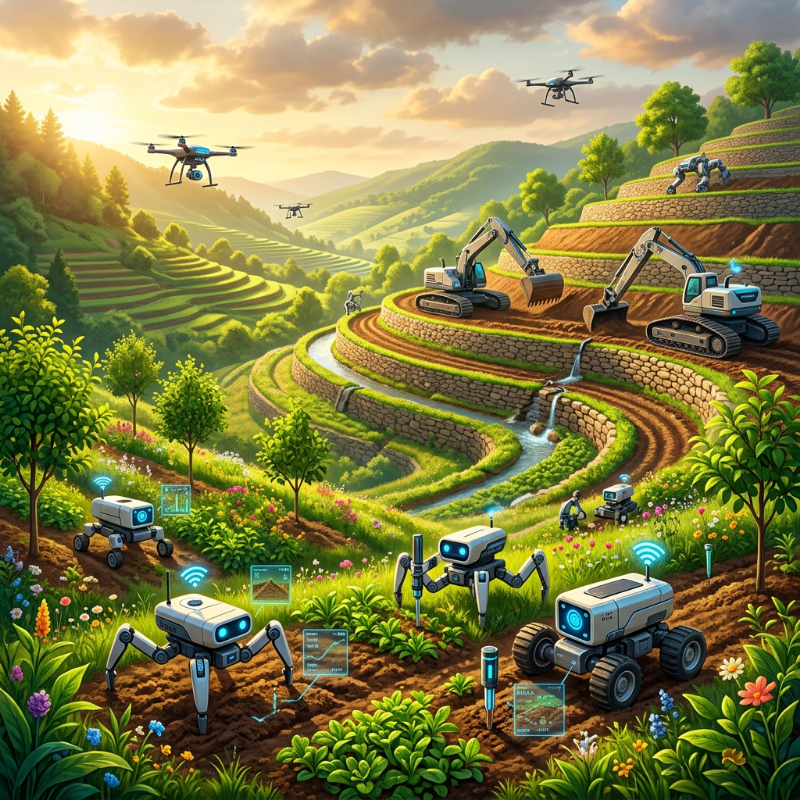
The pace of robotic and drone advancements is dizzying. Every week, their new abilities amaze me. If you work towards it, they will become key tools and helpers in restoring our planet’s ecosystem.
I was asking Claude AI about this last night. It gave some fascinating asnwers, so I made it into a little video. I edited the answer and added my own thoughts down below.
1. Seed Bombing on a Massive Scale
Imagine a fleet of drones flying over a barren desert or a burned area, dropping millions of seed pods. They would be precisely placed and perfectly timed for the rain season.
The AI and planning team guiding them have already studied the soil, the slope, the wind patterns, and the local ecosystem. It knows which seeds need to be dropped where.
What would take an army of humans years to plant, a robot fleet could accomplish in weeks. And they never get tired.
Drones are already being used around the world for cover cropping and planting tree seeds. This will continue to evolve. The drone industry is one to consider joining. You can be an innovator in this space.
2. Soil Health Monitoring of a Wide Area
Healthy soil is the foundation of everything. But now, most farmers and land managers are blind to the state of their environment. They test their soil maybe once a year, if at all. It is expensive, takes time, and samples need to be sent to a lab.
In the near future, imagine small ground robots (maybe little rovers) moving through fields and forests 24/7. They could be reading soil moisture, carbon levels, fungal networks, and nutrient data in real time.
That information could feed directly into a living map of the land. You’d know exactly where the land needs help and what kind of help it needs. I foresee specialized soil scientist AI agents being the brains for these bots.
3. Precision Weeding Without Poison
One of the biggest challenges to regenerative farming is weed control. Right now, the default answer is herbicides which are chemicals that damage the soil life we’re trying to rebuild.
Large robots now exist which identify weeds and kill them with a freakin’ laser beam! The future of robotics will be smaller, coordinated groups of them. Future bots will be solar-powered and remove them mechanically or with that laser without touching a single beneficial plant nearby.
No chemicals. No soil damage. Just precise, intelligent weeding.
4. Water Harvesting and Restoration in Dry Lands
Water is the lifeblood and basis of any restoration project, especially in deserts. Robots could be deployed to build swales, gentle ditches that follow the land’s contour lines and slow water down, sinking it into the earth rather than letting it run off. We are already seeing autonomous tractors. This is another trend I am sure will continue.
Swales are one of the oldest permaculture techniques on Earth. But doing it by hand across thousands of acres? Nearly impossible. With autonomous earth moving robots guided by AI terrain mapping, we could reshape entire landscapes to catch and hold rainfall literally turning dry land green over time.
In projects around the world, these water catching earthworks rehydrate the land, lengthening times that creeks flow and helps build the soil life.
5. Rewilding With Intelligent Habitat Building
Restoring an ecosystem isn’t just about plants. Animals, insects, and birds need shelter, corridors, and nesting zones to return. Robots could be programmed to build wildlife habitat structures such as log placements, rock arrangements, pollinator banks, bird nesting sites.
This could be based on the species that have been detected in the area by sensors and cameras. Large numbers of robots could become partners to nature itself (if we program them correctly). By pairing with AI models, they could be reading what the wild community needs and quietly building it, piece by piece.
The Big Picture of Robotics for Ecological Restoration
None of these five things are science fiction. Every single one is either being used somewhere on Earth right now, or is within reach in the next few years of tech advancement.
The question was never really “Can we do this?” The real question is “Will you decide to be a pioneer in these fields?”
There are entire industries and services waiting to be invented by you.